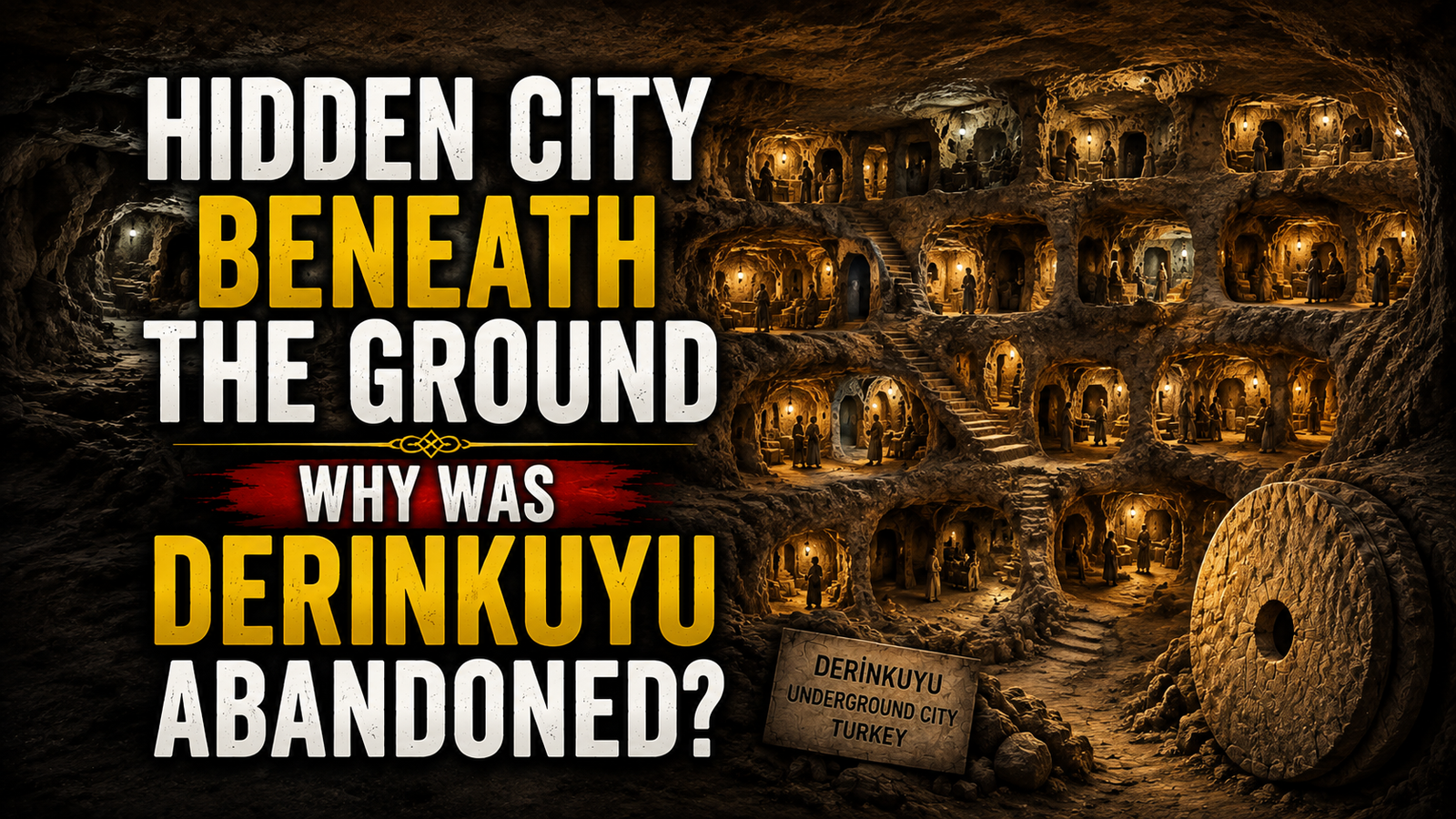
In central Turkey, beneath an ordinary-looking landscape, lies a city that seems almost impossible to believe.
There are tunnels deep underground, rooms carved into volcanic rock, storage areas, places of worship, wells, ventilation shafts, and passages connecting different levels.
This is Derinkuyu, one of the most remarkable underground settlements ever discovered.
The city descends deep beneath the surface and was designed to support people underground for extended periods.
But one question makes the place even more fascinating:
Why was a city like this built in the first place—and why was it eventually abandoned?
Chapter 1 — The Door Beneath the Earth
The story of Derinkuyu begins with something surprisingly ordinary.
In 1963, a man in the Cappadocia region of Turkey was renovating his home when he discovered a hidden room behind a wall.
The room led to something unexpected.
A passage.
Then another.
And another.
As researchers investigated, the discovery became increasingly extraordinary.
The house was connected to an enormous underground network carved directly into the soft volcanic rock beneath the region.
What initially looked like a hidden basement was actually an entrance into a vast underground complex.
The deeper researchers went, the more they found.
Rooms.
Corridors.
Storage spaces.
Stairways.
Wells.
Ventilation shafts.
And passages disappearing into darkness.
The ground beneath the houses wasn’t empty.
It contained an entire hidden world.
Chapter 2 — A City Beneath a City
Derinkuyu is not simply a cave.
It is a carefully organized underground settlement.
The complex contains multiple levels extending deep below the surface.
Different areas served different purposes.
There were rooms for living.
Storage areas for food and supplies.
Animal spaces.
Wells.
Kitchens.
Religious areas.
And narrow corridors connecting different sections.
The city also contained enormous stone doors.
These weren’t ordinary doors.
They were massive circular stones that could be rolled across passageways from inside.
Once closed, they could make access extremely difficult.
That raises an obvious question.
Who were the people trying to protect themselves from?
Chapter 3 — Why Hide Underground?
Cappadocia has a landscape unlike almost anywhere else.
Millions of years of volcanic activity left thick layers of soft rock.
Over time, erosion created the famous formations seen across the region.
But the same rock could also be carved by humans.
This made underground construction possible.
Yet building an underground city on this scale would have required enormous effort.
So why do it?
The most likely answer is security.
Cappadocia experienced repeated periods of conflict and political instability throughout history.
Underground spaces could provide shelter during raids and attacks.
People could move underground.
Food and water could be stored.
Heavy stone doors could block entrances.
Ventilation shafts allowed air to reach deep levels.
The idea wasn’t necessarily to live underground permanently.
It may have been a way to survive when remaining above ground became dangerous.
And Derinkuyu wasn’t alone.
Chapter 4 — Cappadocia’s Hidden World
The region contains hundreds of underground structures, although not all were as large or complex as Derinkuyu.
Some were connected to one another through tunnels.
Others were smaller shelters or storage spaces.
This suggests that underground construction wasn’t a strange one-time experiment.
It was part of a broader tradition in Cappadocia.
But exactly when Derinkuyu was first constructed remains difficult to establish.
Some claims online say the entire city was built thousands of years ago by a single ancient civilization.
The evidence is more complicated.
Different parts of the underground complex may have been carved, expanded, and reused over long periods.
Early inhabitants could have created some sections, while later communities modified them.
Christian communities in the region also used underground spaces, particularly during periods when religious groups faced persecution and instability.
That means Derinkuyu may not have one simple origin story.
It was likely a place that evolved over centuries.
Chapter 5 — Why Was Derinkuyu Abandoned?
Eventually, people stopped using Derinkuyu as an underground settlement.
But there is no single documented event proving that everyone suddenly left on one specific day.
The decline appears to have been connected to broader changes in the region.
As political conditions changed, communities had less need for large underground defensive settlements.
People increasingly lived above ground.
Modern settlements developed.
And the underground complexes gradually lost their original importance.
By the modern period, Derinkuyu had largely disappeared from everyday memory.
Then came the discovery in 1963.
A wall was opened.
A hidden passage appeared.
And the underground city returned to history.
The Mystery of the Stone Doors
Perhaps the most fascinating features of Derinkuyu are the enormous circular stone doors.
These could be moved into position to block passageways.
Once closed, they were difficult to open from the outside.
This suggests that security was an important consideration.
But the doors don’t necessarily prove that Derinkuyu was built exclusively to escape one specific enemy.
The underground city was used over different periods, and its exact functions probably changed.
The stone doors may have been useful during raids, warfare, or other emergencies.
They are evidence of a society that understood one simple principle:
Sometimes the safest place is where nobody can find you.
The Mystery of the Ventilation
One of Derinkuyu’s greatest achievements is something you can’t easily see.
Air.
The deeper people went underground, the more difficult breathing should have become.
Yet the city contains ventilation shafts that carried air through the complex.
Some shafts extend deep into the underground network.
This allowed people to occupy spaces far below the surface without immediately running out of breathable air.
Water was also essential.
Wells and other systems helped provide access to supplies underground.
Together, these features suggest that the settlement wasn’t simply a collection of caves.
It had been deliberately designed to support human life.
How Many People Could Hide There?
One of the most repeated claims about Derinkuyu is that tens of thousands of people could live underground.
Such numbers are difficult to verify precisely.
The site is extensive, but the exact population capacity depends on how different spaces were used and how long people were expected to remain underground.
It is safer to say that Derinkuyu was capable of sheltering a substantial population rather than treating the largest estimates as established fact.
And that makes the site no less impressive.
Even a much smaller population would have required enormous planning.
Food had to be stored.
Animals had to be managed.
Air had to circulate.
Water had to be available.
People needed places to sleep, work, worship, and move.
Everything had to function inside a world without sunlight.
The City That Wasn’t Really a City
There is another fascinating detail.
Calling Derinkuyu a “city” can create the wrong image.
It wasn’t an underground version of modern Istanbul.
There were no underground skyscrapers or permanent urban neighborhoods in the modern sense.
Instead, it was a complex underground settlement designed for shelter, storage, daily activities, and protection.
Some people may have spent considerable time there.
Others may have used it temporarily.
Its purpose could change depending on circumstances.
That makes Derinkuyu even more interesting.
It wasn’t simply a place where people lived.
It was a place where people could disappear.
Why Did People Leave?
By the time the underground complex stopped being important, the world around it had changed.
Political borders shifted.
Religious communities moved.
New settlements developed.
Modern life made underground defensive systems less necessary.
Eventually, Derinkuyu became part of the landscape rather than a living settlement.
Its entrances disappeared behind buildings.
Its tunnels became forgotten.
And the city remained underground while life continued above it.
For generations, people could walk across the surface without realizing that an enormous network existed beneath their feet.
Hidden World Beneath Cappadocia
Today, Derinkuyu is one of Cappadocia’s most remarkable archaeological attractions.
But its greatest mystery isn’t simply how deep it goes.
It’s the story of the people who built and reused it.
They looked at the soft volcanic rock beneath their feet and saw something that could become a shelter.
They carved downward.
Then deeper.
They created rooms and passages.
They engineered ventilation.
They constructed barriers.
They built a hidden environment where entire communities could retreat when the surface became dangerous.
And then, eventually, they stopped needing it.
In Nutshell
Derinkuyu is a vast underground settlement in Cappadocia, Turkey, discovered in its modern form in 1963 after a hidden room was uncovered beneath a house. Its multi-level tunnels, storage areas, wells, ventilation shafts, religious spaces, and stone doors show that people used the underground complex for shelter and other purposes over different periods.
Its exact origins are complicated, with sections likely constructed and modified over centuries. Warfare, raids, political instability, and religious persecution may have increased the value of underground refuge at different times. Eventually, changing conditions reduced the need for such settlements, and Derinkuyu was gradually abandoned.
The city wasn’t destroyed in one dramatic event.
It simply became unnecessary.
And for centuries, one of Cappadocia’s most extraordinary human creations remained hidden beneath the ground—a city that disappeared without actually going anywhere.