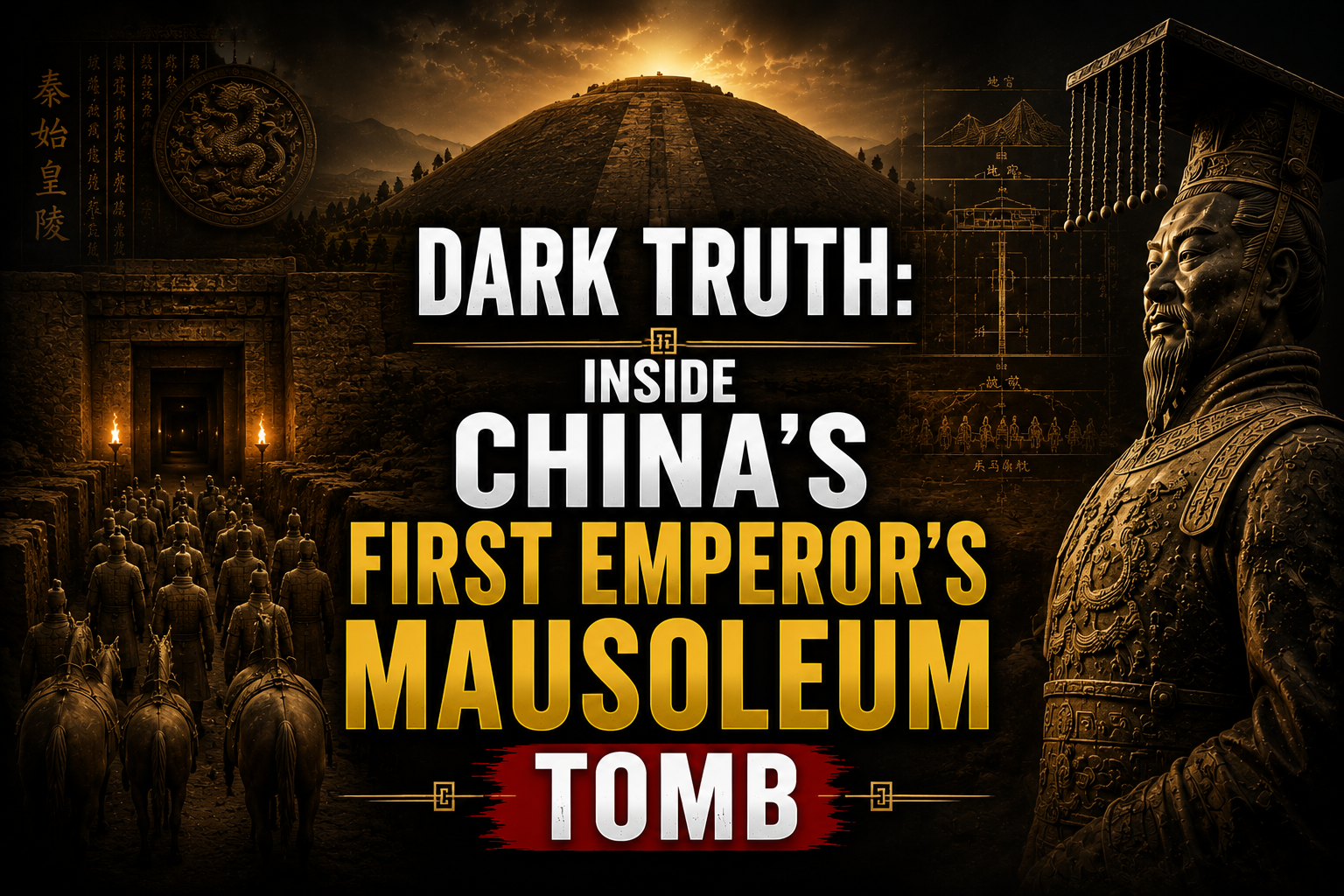
More than 2,200 years ago, one of China’s most powerful rulers was buried beneath a massive mound near modern-day Xi’an.
His name was Qin Shi Huang, the first emperor to unite China.
He built roads, standardized writing and measurements, strengthened defenses, and created an empire that would shape Chinese history.
But his greatest project may have been the one he built for death.
Somewhere beneath the earth lies his enormous underground mausoleum.
And despite everything archaeologists have already discovered around it, the emperor’s central tomb chamber remains unopened.
What could still be inside?
Emperor Who Wanted an Empire Beyond Death
Qin Shi Huang was born in 259 BCE, when China was divided among competing states.
By 221 BCE, Qin forces had defeated their major rivals. The ruler declared himself the First Emperor and began transforming the newly unified territories into a centralized empire.
But Qin Shi Huang wasn’t thinking only about his life.
Construction of his mausoleum began while he was still young.
According to the ancient historian Sima Qian, enormous numbers of workers were involved in creating the underground complex.
The emperor’s burial wasn’t intended to be an ordinary grave.
It was designed to reproduce his world.
And thousands of clay soldiers would eventually prove just how ambitious that vision was.
Discovery That Changed Everything
For centuries, nobody knew the full scale of what was buried near the emperor’s tomb.
Then, in 1974, local farmers digging a well near Xi’an uncovered fragments of terracotta figures.
Archaeologists arrived.
What they found beneath the ground was astonishing.
Rows of life-sized soldiers were standing in enormous underground pits.
Infantrymen.
Archers.
Officers.
Cavalry.
Horses.
Chariots.
Thousands of figures had been created to protect the emperor in the afterlife.
The discovery became known as the Terracotta Army.
But the soldiers weren’t Qin Shi Huang’s actual tomb.
They were only part of the enormous mausoleum complex.
The emperor himself remained underground.
An Army Beneath the Earth
The Terracotta Army wasn’t made up of identical little statues.
The figures are life-sized and show different ranks, clothing, hairstyles, and military positions.
Many were originally painted in vivid colors.
Real bronze weapons were also placed with the soldiers, including swords, spearheads, and arrowheads.
The scale of the project is difficult to comprehend.
The emperor had essentially created an underground military force for his journey into the next world.
And the army wasn’t alone.
Archaeologists discovered additional pits containing horses, officials, performers, animals, and other objects.
Piece by piece, the buried complex began to resemble an entire imperial world.
But one place remained untouched.
The emperor’s central tomb.
Tomb Nobody Has Opened
The central burial chamber lies beneath the large mound at the heart of the mausoleum.
Archaeologists know where it is.
They have studied the surrounding area.
They have discovered structures and artifacts nearby.
But they have never excavated the central chamber itself.
That decision has preserved one of archaeology’s greatest mysteries.
Because an ancient text claims the chamber could contain something extraordinary.
Rivers of Mercury Beneath the Earth
Sima Qian’s Records of the Grand Historian, written roughly a century after Qin Shi Huang’s death, describes the underground palace.
According to his account, the tomb contained representations of the emperor’s empire, including rivers and seas made from mercury.
The story sounds almost impossible.
Then scientists found something interesting.
Research around the mausoleum has detected elevated mercury concentrations in the soil.
That doesn’t prove there are underground rivers of mercury.
But the finding has made Sima Qian’s ancient description considerably more intriguing.
If mercury really was used inside the tomb, why?
Perhaps it symbolized China’s rivers and seas.
Perhaps it had another ritual purpose.
Or perhaps the ancient account exaggerated what was actually there.
Until the chamber is investigated, nobody can know for certain.
Why Don’t They Simply Open It?
The obvious question is:
Why not excavate the tomb and find out?
The answer is preservation.
Archaeologists learned an important lesson from the Terracotta Army.
When some soldiers were excavated, traces of their original paint were still visible.
But once exposed to air, many of those delicate pigments deteriorated rapidly.
The central tomb could contain materials that are even more fragile.
Paintings.
Textiles.
Wood.
Organic remains.
Ancient documents.
Or objects that have survived only because they have remained sealed underground.
Opening the chamber could expose everything inside to oxygen, humidity, microorganisms, and sudden environmental changes.
If something were destroyed during excavation, there would be no second chance.
So archaeologists have generally favored studying the tomb using non-invasive methods rather than opening it prematurely.
What About the Ancient Traps?
Sima Qian also described another frightening detail.
According to his account, craftsmen installed crossbows and arrows designed to fire at anyone attempting to enter the tomb.
It sounds like something from an adventure movie.
But there is no modern evidence confirming that such traps still exist.
Even if mechanical devices were originally installed, thousands of years underground could have left them damaged or useless.
For now, the ancient description remains just that—a historical account waiting to be tested.
Qin Shi Huang Was Obsessed With Immortality
There is an even darker irony behind the tomb.
Qin Shi Huang reportedly searched for ways to extend his life.
Ancient sources describe his interest in medicines and substances believed to have life-extending properties.
He died in 210 BCE while traveling through his empire.
Some historians have suggested that mercury-containing substances associated with ancient attempts at immortality may have contributed to his death, although his exact cause of death cannot be established with certainty.
The emperor who wanted to defeat death eventually became trapped inside the tomb he had prepared for himself.
Then His Empire Collapsed
Qin Shi Huang’s dynasty didn’t survive for long after his death.
The Qin dynasty collapsed in 206 BCE, only a few years after the emperor died.
His political empire was gone.
But his underground empire remained.
The Terracotta Army stayed buried.
The central tomb stayed sealed.
And generation after generation passed over the mound without knowing exactly what lay beneath it.
For more than two thousand years, the emperor’s final palace remained hidden.
People Who Found His Army Never Found Him
The Terracotta Army discovery in 1974 revealed how enormous Qin Shi Huang’s burial complex really was.
But the central mystery survived.
Archaeologists have found thousands of warriors.
They have found weapons.
They have found horses and chariots.
They have found performers, officials, animals, and other funerary objects.
Yet the emperor’s own burial chamber remains beyond reach.
It creates an extraordinary situation:
We have discovered the army protecting the emperor, but we still haven’t seen the emperor’s tomb.
What Could Be Inside?
Nobody can honestly say exactly what remains in the chamber.
Ancient descriptions suggest an elaborate underground palace.
Archaeologists have evidence that the mausoleum was built on an enormous scale.
Mercury has been detected around the mound.
But the chamber itself hasn’t been opened.
So theories about priceless treasures, hidden documents, elaborate mechanisms, or perfectly preserved objects remain theories.
The greatest mystery isn’t knowing that something is there.
It’s knowing that something is there without being able to see it.
Tomb May Stay Closed for Years
Technology is changing archaeology.
Scientists can now investigate ancient sites using remote sensing, geophysical surveys, and other methods that don’t require immediate excavation.
One day, researchers may have techniques capable of examining the chamber while protecting everything inside.
Until then, opening the tomb could be considered too risky.
After more than 2,000 years, waiting another few decades may be a small price to pay if it prevents the destruction of irreplaceable evidence.
And the emperor isn’t going anywhere.
The Final Mystery
Qin Shi Huang wanted to create an empire that would survive him.
His dynasty collapsed within years.
His political system disappeared.
But his tomb endured.
The Terracotta Army now stands as one of the most remarkable archaeological discoveries ever made.
Yet beneath the same landscape is something even more mysterious.
A sealed chamber.
An emperor.
Ancient descriptions of underground rivers.
Unusually high mercury readings around the mausoleum.
And thousands of years of unanswered questions.
Perhaps the tomb contains exactly what Sima Qian described.
Perhaps later generations embellished the story.
Perhaps the reality is stranger than either possibility.
For now, there is only one thing we know for certain.
The greatest secret of Qin Shi Huang’s mausoleum is still underground.
And until archaeologists finally open that ancient chamber, China’s first emperor will remain one of history’s most mysterious rulers—still surrounded by an empire he built for eternity.