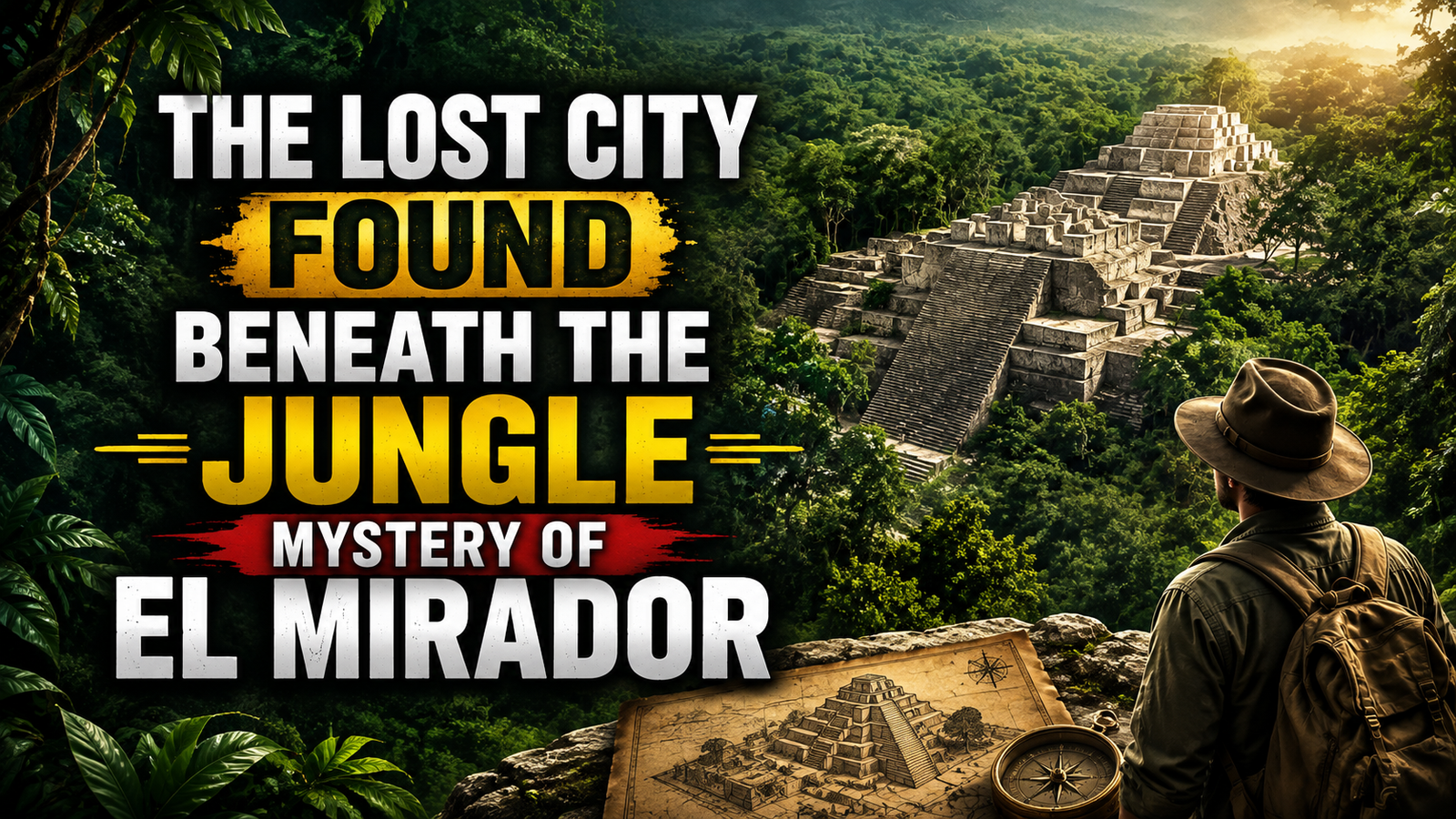
Deep in Guatemala’s Petén rainforest, beneath layers of trees and vegetation, lies the remains of a city that once belonged to one of the ancient Americas’ most powerful civilizations. El Mirador was already a major Maya center more than 2,000 years ago, long before the famous Maya cities of the Classic period reached their peak.
Its enormous pyramids, monumental architecture, ancient causeways, and hidden structures reveal a civilization far more advanced and organized than researchers once imagined. But after centuries of growth, El Mirador declined and was eventually swallowed by the jungle.
Today, archaeologists are still trying to understand how this enormous city rose, why it declined, and what its ruins reveal about the mysterious beginnings of Maya civilization.
Chapter 1 — The City Hidden Under the Jungle
Deep inside northern Guatemala’s Petén rainforest, far from modern cities and roads, lies a place that remained hidden from the outside world for centuries.
There are no modern streets leading through it.
No crowded neighborhoods.
No obvious signs that a huge ancient city once stood there.
Instead, there is jungle.
Dense vegetation covers enormous structures, hills, plazas, and pyramids.
But beneath that green landscape is El Mirador—one of the largest and earliest known Maya urban centers.
For centuries, the rainforest concealed what had once been a powerful city.
When archaeologists began studying the site, they discovered something extraordinary.
Some of the hills weren’t natural hills at all.
They were enormous ancient structures.
And one of them was so massive that it would eventually become one of the most impressive Maya monuments ever discovered.
Its name is La Danta.
Chapter 2 — The Pyramid That Was Hiding in Plain Sight
From the ground, El Mirador can be difficult to understand.
The rainforest is so dense that ancient structures can appear to be nothing more than natural rises in the landscape.
That helped protect the city for centuries.
But archaeologists gradually began revealing what was underneath.
La Danta rises roughly 70 meters above the surrounding landscape, and its enormous platform system covers a huge area.
Rather than being a simple pyramid, it is part of a massive architectural complex made up of terraces, platforms, stairways, and structures.
The scale is remarkable considering how early the city developed.
El Mirador flourished centuries before the famous Maya cities of the Classic period reached their height.
Researchers have found evidence that major construction at the site began during the Preclassic period, with the city reaching its greatest development roughly between 300 BCE and 100 CE.
This changed an old assumption about Maya civilization.
For a long time, scholars knew the Maya for their later cities, writing, astronomy, mathematics, and monumental architecture.
El Mirador showed that complex Maya urban life had deep roots.
The Maya weren’t suddenly building great cities centuries later.
They had already been doing it.
Chapter 3 — A City Larger Than Anyone Expected
As archaeologists mapped El Mirador, the scale of the settlement became increasingly difficult to ignore.
This wasn’t simply a ceremonial center with a few pyramids.
It was a massive urban landscape.
Researchers identified enormous architectural complexes connected by broad raised causeways known as sacbeob.
These causeways connected different parts of the city and allowed movement through the landscape.
Some extended for considerable distances.
The city also contained reservoirs, plazas, monumental structures, residential areas, and sophisticated water-management features.
But perhaps the strangest discovery was hidden on the walls of one enormous structure.
A giant carved representation of the Maya Hero Twins, figures associated with the Maya mythological tradition later recorded in the Popol Vuh.
The artwork suggests that mythology and political power were already deeply connected at El Mirador.
The city wasn’t just large.
It had a complex worldview.
Chapter 4 — Why Did El Mirador Decline?
And then the story takes a darker turn.
After centuries of growth, El Mirador began to decline.
By roughly the second century CE, the city had largely lost its importance as a major urban center.
People didn’t simply vanish overnight.
The decline appears to have been gradual and complicated.
Researchers have considered several possible factors.
Environmental pressure may have played a role.
The city depended on agriculture and water management, and maintaining such a large population in the rainforest would have required enormous resources.
Political instability may also have contributed.
Competition between Maya centers could disrupt trade and weaken powerful cities.
There is also evidence of changing settlement patterns across the region.
Eventually, El Mirador was largely abandoned.
The jungle slowly reclaimed it.
Trees grew over plazas.
Roots pushed through ancient structures.
Vegetation covered stairways.
The monumental city became almost indistinguishable from the natural landscape.
And then something extraordinary happened.
It was forgotten.
Chapter 5 — The Lost City Returns
El Mirador wasn’t completely unknown to local communities, but for the outside archaeological world, the site remained extremely difficult to access.
Early explorers reached the region in the 19th and early 20th centuries.
But the remote rainforest made serious archaeological investigation extremely challenging.
That began to change in the late 20th century.
Archaeologists started mapping and excavating the site more systematically.
Then new technology transformed the investigation.
LiDAR, a laser-based remote-sensing technique, allowed researchers to see through the forest canopy and map the landscape beneath it.
The results were astonishing.
The rainforest was hiding far more ancient architecture than researchers could see from the ground.
Roads.
Platforms.
Buildings.
Reservoirs.
Settlements.
A vast interconnected urban landscape emerged from beneath the trees.
The jungle hadn’t erased the city.
It had simply hidden it.
And El Mirador became one of the clearest reminders that the ancient Maya world was much larger and more complex than previously imagined.
The Mystery That Remains
Today, El Mirador still raises difficult questions.
How did people build such enormous monuments so early?
How was food produced for such a large population?
How did workers transport enormous quantities of limestone?
How did the city organize its labor?
And perhaps most importantly:
Why did a city of such extraordinary scale eventually decline?
There is no single answer.
El Mirador’s story appears to involve a combination of environmental, economic, political, and social changes.
And that’s what makes the ruins so fascinating.
This wasn’t a civilization that simply disappeared.
Its people moved, adapted, and continued living across the Maya world.
But the enormous urban center they had created was gradually abandoned.
Then the rainforest took over.
For centuries, the city disappeared beneath trees.
Until archaeologists began looking again.
The City Jungle Couldn’t Erase
Standing at El Mirador today, it’s difficult to imagine the ancient city beneath the vegetation.
The rainforest appears endless.
But beneath it are monumental structures created more than two thousand years ago.
La Danta still rises above the landscape.
Ancient causeways still reveal the organization of the city.
Carved monuments preserve pieces of its mythology.
And the ruins continue to challenge what historians once believed about early Maya civilization.
El Mirador wasn’t simply a lost city.
It was evidence that complex Maya urban civilization emerged much earlier than many people once imagined.
And perhaps the most remarkable part of its story is not that it was abandoned.
It’s that the jungle managed to hide one of the ancient world’s greatest cities for so long.
The city was never truly gone.
It was simply waiting beneath the trees to be found again.
In Nutshell
El Mirador was one of the earliest and largest Maya urban centers, hidden for centuries beneath Guatemala’s rainforest. Its enormous structures—especially the massive La Danta complex—show that Maya civilization was building monumental cities much earlier than previously assumed.
The city declined around the early centuries CE, likely because of a combination of environmental, political, and economic pressures.
Modern archaeology and LiDAR technology have revealed that beneath the jungle lies a vast interconnected landscape of ancient settlements, roads, reservoirs, and monuments—turning El Mirador into one of the most fascinating lost cities of the ancient world.