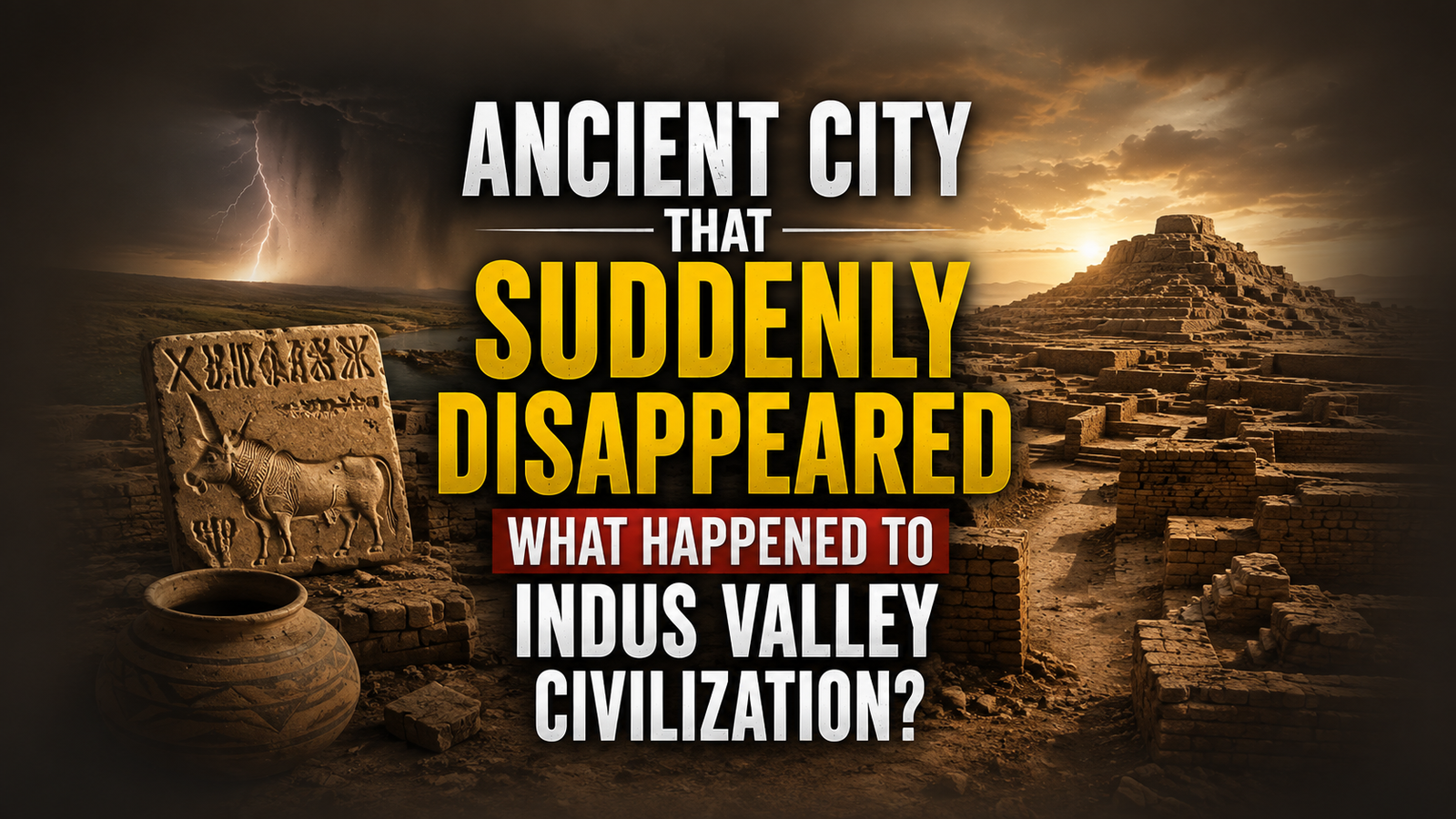
Imagine walking through a city that was built more than 4,000 years ago.
The streets are laid out in an almost astonishingly orderly pattern. Houses have wells. Wastewater disappears through carefully constructed drains. Bricks are standardized. Goods appear to have traveled hundreds, perhaps thousands, of miles.
And then you notice something strange.
There are no grand royal palaces dominating the city.
No giant monuments celebrating a conquering king.
And, most mysteriously, the civilization that built these cities eventually stops building cities like them.
For centuries, archaeologists have been trying to understand what happened.
This was the Indus Valley Civilization, one of the earliest urban civilizations in human history.
Its people built enormous settlements across parts of modern-day Pakistan and northwestern India. They developed sophisticated systems of water management, trade, craft production, and urban planning.
Then, after centuries of prosperity, their great cities began to decline.
But there was no single dramatic moment when the civilization simply vanished.
The real mystery is more complicated.
And perhaps more fascinating.
Civilization Hidden Beneath the Ground
For thousands of years, the cities of the Indus civilization were largely forgotten.
Then, during the 19th and early 20th centuries, archaeologists began uncovering evidence that something extraordinary had existed there long before the better-known civilizations of Greece and Rome.
Among the most important discoveries were Harappa and Mohenjo-daro.
These weren’t small villages.
They were major urban settlements.
Their streets, drainage systems, brick architecture, wells, workshops, storage areas, and residential neighborhoods revealed a society capable of coordinating enormous numbers of people.
The discovery changed the story of ancient civilization.
The Indus world wasn’t simply an isolated collection of farming villages.
It had become an interconnected urban society.
And then came the question that still refuses to disappear:
Why did its cities decline?
Cities Were Far More Advanced Than Expected
At first, the ruins could seem almost ordinary.
Then archaeologists began looking closer.
At Mohenjo-daro, they found sophisticated drainage infrastructure running through the settlement.
Many houses were connected to systems designed to move wastewater away from living areas.
Wells provided access to water.
Bricks were produced using remarkably consistent proportions across large parts of the civilization.
The planning suggested something important.
These communities weren’t growing randomly.
Someone—or more accurately, a complex social system—was organizing them.
The Indus civilization also maintained long-distance trade.
Archaeological evidence connects Indus communities with regions including Mesopotamia, Oman, and parts of Central Asia.
Indus seals and other artifacts have been discovered far beyond the core cities.
Their world was connected.
But then the urban system began changing.
And Then Something Changed
The decline wasn’t a single night.
There was no known invasion that suddenly erased every city.
There wasn’t one giant earthquake that destroyed the entire civilization.
Instead, archaeologists see a long process of transformation.
After roughly 1900 BCE, many of the large urban settlements associated with the Mature Harappan period experienced major changes.
Large cities became less prominent.
Some settlements were abandoned.
Trade networks changed.
Material culture changed.
People increasingly lived in smaller settlements spread across different regions.
This is one reason the phrase “the Indus Valley Civilization disappeared” can be misleading.
The people didn’t simply vanish.
Their urban civilization changed.
And some of their descendants and cultural traditions continued in different forms.
The mystery, therefore, isn’t:
Where did everybody go?
It’s:
Why did the great urban system break down?
Theory One: The Climate Started Changing
One of the strongest explanations involves the environment.
The Indus civilization depended heavily on water.
Agriculture required predictable rainfall and river systems.
Cities required reliable supplies of fresh water.
Trade routes also depended on functioning landscapes and rivers.
But the climate of South Asia wasn’t always stable.
Researchers have found evidence suggesting that the region experienced changes in rainfall patterns around the period when the urban system began declining.
Some studies have linked weakening monsoon conditions with the transformation of Indus settlements.
If rainfall became less reliable, agricultural production could have become harder.
And if farming became less predictable, large urban populations would have been increasingly difficult to support.
But climate change alone may not explain everything.
Because the Indus civilization occupied a huge geographical area.
Different regions experienced environmental changes differently.
That means the answer may not be one massive drought.
It may have been a slow series of environmental stresses.
The River Mystery
Then there is another fascinating possibility.
Rivers.
The Indus civilization developed around some of the most important river systems in South Asia.
But rivers are not permanent.
They change course.
They flood.
They dry.
They migrate across landscapes.
And some ancient river channels are no longer flowing today.
Archaeologists and geologists have spent decades investigating ancient river systems associated with the Indus world.
One major area of research concerns the Ghaggar-Hakra river system, sometimes associated with the ancient Saraswati described in later Indian texts.
But this subject is controversial.
Different researchers disagree about exactly which ancient rivers existed, when they flowed, and how important their changes were to Harappan settlements.
What is clearer is that river dynamics mattered.
A settlement dependent on a particular water source could become vulnerable if that water source shifted.
And this may have happened repeatedly across the civilization’s enormous territory.
What About the Famous “Lost River”?
This is where the story becomes especially complicated.
For decades, researchers have wondered whether the Ghaggar-Hakra system once carried a much larger river than it does today.
Some theories connect it to the ancient Saraswati River mentioned in Vedic literature.
But archaeologists have warned against turning this into a simple story.
The archaeological evidence does not prove a single straightforward scenario in which one enormous river suddenly disappeared and took the entire civilization with it.
Instead, research suggests a much more complicated history involving changing river channels, monsoon patterns, groundwater, and regional settlement shifts.
In other words:
The river mystery may be part of the story—but probably not the entire story.
Then There Is the Invasion Theory
For decades, another explanation was extremely popular.
An invading population supposedly entered the region, destroyed the cities, and brought the Indus civilization to an end.
The idea became associated with evidence such as skeletons found at Mohenjo-daro.
It made for a dramatic story.
But archaeology became less supportive of the simplest version of that explanation.
There is no convincing evidence of a single massive military invasion destroying the entire civilization.
The skeletal evidence once used to support the idea has been reexamined.
And the broader archaeological record doesn’t show the kind of widespread destruction expected from a civilization-ending military conquest.
That doesn’t mean conflict never happened.
Ancient societies certainly experienced violence.
But the evidence doesn’t support a simple story of:
Invaders arrive → cities are attacked → civilization disappears.
The reality appears to have been much slower.
The Mystery Hidden in the Skeletons
Mohenjo-daro has produced another enduring mystery.
Human remains were discovered in different parts of the city.
For years, popular accounts suggested that these people had been massacred.
Some versions of the story even imagined a final battle in the streets.
It sounds like the perfect ending to a lost civilization.
But archaeological interpretation is more complicated.
The skeletons don’t provide strong evidence for a single massacre that destroyed Mohenjo-daro.
Their positions and archaeological contexts have been debated, and later interpretations have challenged the old “massacre” narrative.
So the famous story of a city suddenly destroyed by invaders doesn’t fit the evidence nearly as neatly as popular history sometimes suggests.
The real ending was quieter.
And possibly more devastating.
The Cities Started Losing Their Urban Character
By the later stages of the civilization, something fundamental had changed.
Large urban centers became less dominant.
Long-distance trade networks weakened.
Craft traditions changed.
Standardized systems became less widespread.
People increasingly occupied smaller settlements.
This is sometimes described as deurbanization.
And the word matters.
Because it doesn’t mean the people disappeared.
It means the urban system disappeared.
The civilization’s population didn’t evaporate.
Instead, communities adapted.
People moved.
Economic systems changed.
Settlement patterns shifted.
Large cities became less important.
The Indus world was transforming from a highly urbanized society into something more decentralized.
Where Did the People Go?
This is one of the most common questions.
If the cities were abandoned, where did their inhabitants go?
The answer appears to be:
Many went nowhere far away.
Evidence suggests that populations shifted toward smaller settlements, particularly in regions where agricultural conditions remained favorable.
Instead of living in enormous urban centers, communities became more dispersed.
This may have been a rational response to changing environmental and economic conditions.
If large cities became harder to maintain, smaller settlements could have offered advantages.
People could adapt their farming.
They could move closer to reliable water.
They could reorganize trade.
They could change how they produced food.
The civilization didn’t necessarily die.
It changed its way of living.
And Then the Famous Indus Script Became Silent
Perhaps the most frustrating mystery is the writing.
The Indus civilization left behind hundreds of seals and inscriptions.
But there is a problem.
We still cannot confidently read the Indus script.
Researchers have identified patterns and studied its signs for decades.
But there is no universally accepted decipherment.
That means the people who built these cities left behind written evidence that we still cannot fully understand.
Imagine finding the ruins of an entire ancient civilization—but being unable to read its own words.
That limitation affects everything.
We don’t know what the people called themselves.
We don’t know what their kings—or political leaders—were called.
We don’t know exactly what their religious texts said.
And we don’t have an Indus document explaining:
“This is why our cities were abandoned.”
The civilization left clues.
But no final explanation.
There Was No Single “End”
This may be the most important discovery of all.
The Indus civilization didn’t have a single end date.
Different regions changed at different times.
Some settlements declined.
Others continued.
Some communities shifted toward new economic and cultural systems.
This means that searching for one catastrophic event may be asking the wrong question.
Instead, researchers increasingly examine a combination of factors:
Climate.
Water availability.
River changes.
Agricultural adaptation.
Trade disruption.
Population movement.
Changing social organization.
Each factor could have affected the others.
Imagine a city that depends on farming.
Rainfall becomes less reliable.
Harvests become harder.
Trade becomes less predictable.
Maintaining large urban infrastructure becomes expensive.
Families move toward smaller settlements.
As population falls, major public systems become harder to maintain.
Then the city slowly loses its importance.
No explosion.
No final battle.
No dramatic final day.
Just a gradual unraveling.
The Great Cities Became Ghosts
Eventually, places such as Mohenjo-daro no longer functioned as they once had.
The streets remained.
The wells remained.
The bricks remained.
The drainage systems remained.
But the society that had created them had transformed.
That is what makes the ruins so haunting.
They don’t look like the remains of a civilization that was simply destroyed.
They look like the remains of a civilization that changed beyond recognition.
And that may be even more mysterious.
So What Really Happened?
After more than a century of archaeological research, there is still no single universally accepted explanation.
But the evidence strongly suggests that the old dramatic story is wrong.
The Indus civilization probably wasn’t destroyed by one invading army.
It wasn’t wiped out by one sudden catastrophe.
And its people didn’t simply disappear.
Instead, the great urban civilization underwent a long period of transformation beginning around the end of the Mature Harappan period, around 1900 BCE.
Environmental changes appear to have played an important role.
Changes in monsoon rainfall and river systems may have placed pressure on agriculture and settlement.
Economic and trade networks also changed.
Communities adapted by becoming more dispersed and relying on different settlement patterns.
The civilization’s urban centers declined.
But the people continued.
Civilization That Didn’t Really Disappear
Perhaps the greatest irony is hidden in the title of the mystery.
The Indus Valley Civilization didn’t truly disappear.
Its urban system disappeared.
Its cities declined.
Its distinctive cultural system transformed.
But human communities remained in South Asia.
They adapted to changing circumstances.
And archaeological evidence suggests continuity and transformation rather than a simple extinction event.
That’s why the mystery remains so fascinating.
We’re not looking at a civilization that vanished without a trace.
We’re looking at a civilization that left thousands of traces—cities, pottery, tools, seals, roads, wells, burials, agricultural evidence and countless fragments of daily life.
Yet those fragments don’t give us one final answer.
The Final Mystery
Stand at the ruins of Mohenjo-daro today and imagine the city when it was alive.
People walking through streets.
Workers producing pottery.
Merchants moving goods.
Families drawing water from wells.
Craftspeople making objects that would eventually travel across distant regions.
The city was not dead.
It was part of a vast and interconnected world.
Then something changed.
Perhaps the monsoon weakened.
Perhaps rivers shifted.
Perhaps agriculture became more difficult.
Perhaps trade networks became less reliable.
Perhaps several of these things happened together.
And slowly, the great cities lost their power.
The streets became quieter.
The workshops stopped.
The urban system fractured.
And eventually, one of the world’s earliest great civilizations entered a completely different phase.
But its final explanation remains buried beneath the same soil where archaeologists continue to search.
And perhaps the strangest part of the story is this:
The Indus people left behind an entire civilization for us to discover—but they never left behind the one message we want most.
They never told us exactly why they left their cities.
And more than 4,000 years later, we’re still trying to figure it out.