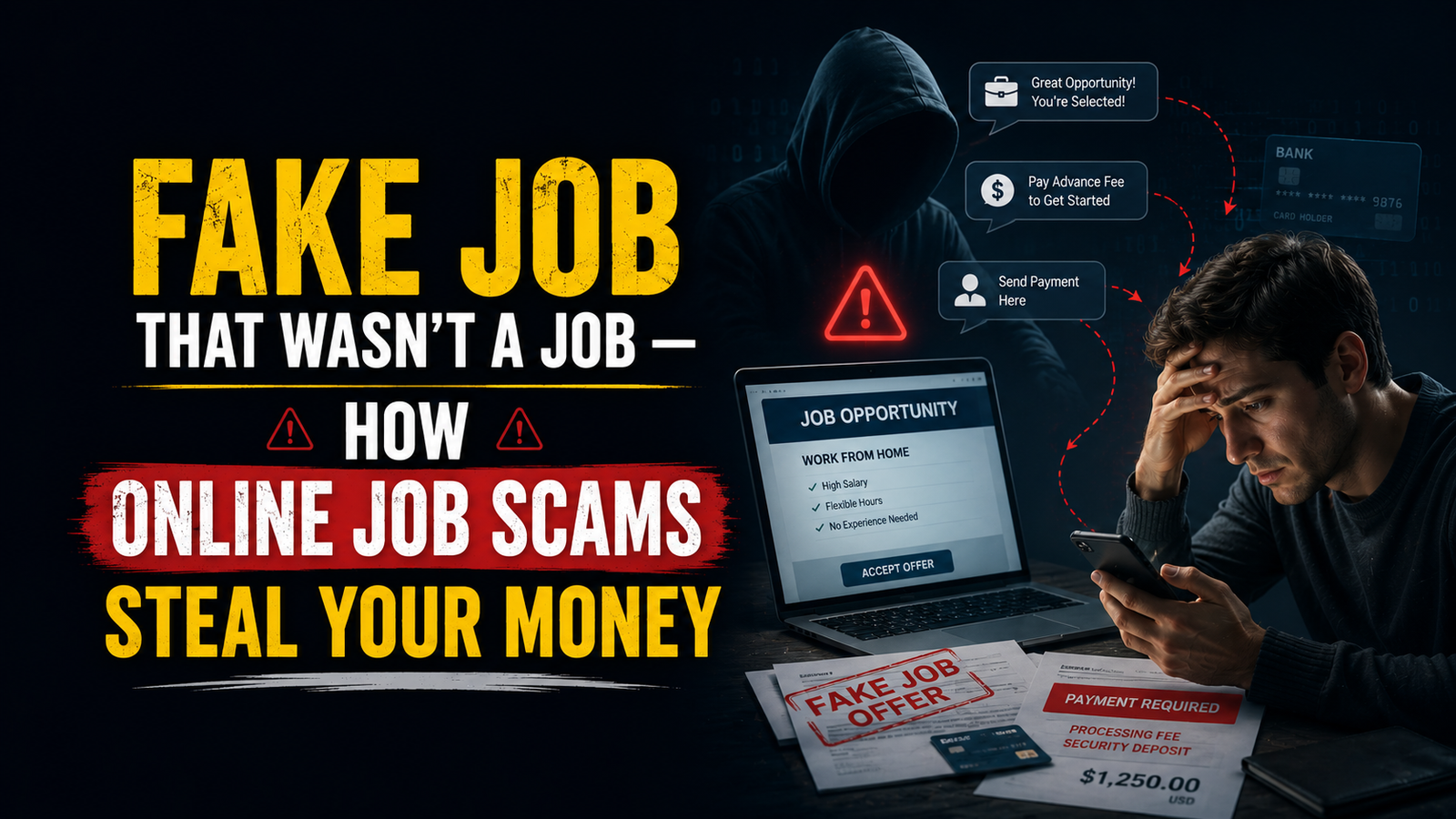
The message looks like a dream opportunity.
“Congratulations! Your profile has been selected for a remote position.”
The salary looks attractive.
The hours are flexible.
There is no complicated interview process.
Sometimes, the recruiter even claims to represent a recognizable company.
For someone searching for work, it can feel like extraordinary luck.
Then comes the first request.
Maybe it’s a small payment for training.
Maybe they ask you to purchase equipment.
Maybe they send a check and tell you to transfer part of the money somewhere else.
Or perhaps they ask you to deposit money into an online platform so you can complete “tasks” and unlock commissions.
At first, everything looks like employment.
But there is one problem.
There was never a job.
The Message From the “Recruiter”
It often begins with a text, email, social-media message, or online job listing.
The recruiter sounds professional.
They may use a company logo.
Their profile may contain a convincing job title.
The email address might even look similar to a legitimate business address.
The position itself sounds believable:
- Remote customer service
- Data entry
- Virtual assistant
- Administrative assistant
- Product evaluator
- Online marketing
- “Optimization” work
- Mystery shopping
Nothing about the job description necessarily looks absurd.
And that’s important.
A scam doesn’t have to look ridiculous.
It only has to look possible.
The First Red Flag Is Often the Easiest to Miss
A legitimate employer normally wants to know whether you can actually perform the job.
That means some combination of applications, interviews, skills assessments, references, or other hiring procedures may occur.
A scammer, however, may be far less interested in your qualifications.
Instead, they’re interested in getting you to the next stage.
The faster the process moves, the less time you have to investigate.
That’s why an offer that appears almost immediately after a short conversation should make you cautious.
Especially when the salary is unusually high for the amount of experience required.
Then They Ask for Money
This is where the “job” begins to reveal itself.
The recruiter might say you need to pay for:
Training.
Equipment.
Software.
Background checks.
Certification.
Administrative processing.
The amount may initially seem manageable.
Perhaps it’s only $50.
Or $100.
Or a few hundred dollars.
But a legitimate employer generally shouldn’t require a job applicant to pay money simply to receive a job.
The scammer wants the payment because the payment is the real business model.
The Check That Looks Like a Salary
One of the more dangerous versions involves fake checks.
Imagine receiving an email saying you’ve been hired.
A few days later, a check arrives.
It may look completely legitimate.
The recruiter tells you to deposit it.
Your bank account appears to show the money.
Then comes the instruction:
“You need to purchase equipment from our approved vendor.”
Or:
“Send part of the money to our supplier.”
So you transfer the requested amount.
You may even believe you’re using money supplied by your new employer.
But eventually, the bank discovers that the check is fraudulent.
The deposit is reversed.
The money you sent is gone.
And suddenly, the “salary” was never a salary at all.
Why Would a Bank Show the Money?
This is one of the reasons fake-check employment scams can be so convincing.
A deposited check can appear as available funds before the financial institution has completed the entire verification process.
That doesn’t necessarily mean the check has been confirmed as legitimate.
Scammers exploit the gap between money appearing available and the check actually clearing.
By the time the fraud is detected, the victim may already have sent real money to the criminal.
The victim isn’t receiving money.
They’re unknowingly transferring their own money.
Another Scam: The Job Where You Must Deposit Money
Some online employment scams use a completely different strategy.
The recruiter tells you that you’re working for an online company.
Your job is to perform simple tasks.
You may be asked to rate products, optimize listings, complete transactions, or increase rankings.
The website shows your earnings increasing.
Then suddenly:
You need to deposit money to continue.
You pay.
Your account balance increases.
Then another level appears.
Another deposit is required.
The system may even show impressive “commissions.”
But those numbers don’t necessarily represent real money.
They’re simply numbers displayed on a platform controlled by the scammer.
The Psychological Trap
This is where the scam becomes much more sophisticated.
The victim doesn’t necessarily think:
“I’m sending money to a criminal.”
They think:
“I’m investing in my new job.”
That difference matters.
The word job changes how the transaction feels.
A person who would never send money to a stranger might still pay $200 if they believe it’s necessary to secure employment.
The scammer is exploiting something incredibly powerful:
the desire to earn money rather than lose it.
Why Desperate Job Seekers Can Be Especially Vulnerable
Looking for employment can be stressful.
Someone may be unemployed.
They may have bills due.
They may need flexible work.
They may have recently lost a job.
A message promising immediate remote employment can therefore arrive at exactly the right psychological moment.
The scammer doesn’t need to convince the victim that they’re giving away money.
They only need to convince them:
“This is the step I need to take to start earning.”
Once that belief is established, the payment can seem reasonable.
The Fake Interview
Some scammers understand that an immediate job offer looks suspicious.
So they create an interview.
It may happen through messaging apps.
The “interviewer” asks basic questions.
They discuss responsibilities.
They may send an employment contract.
They may even provide onboarding documents.
Everything appears official.
But none of these things prove that the person is actually connected to the company.
A professional-looking document can be created in minutes.
A company logo can be copied.
A fake employee profile can be created.
The appearance of legitimacy is not the same thing as legitimacy.
The Company Name May Be Real
This is one of the most dangerous variations.
The scammer may impersonate a genuine company.
They can copy:
- Company logos
- Employee names
- Job descriptions
- Corporate websites
- LinkedIn profiles
- Recruiting language
- Branding
A victim searches the company online.
The company exists.
The website is real.
The employees are real.
So the victim assumes the recruiter must be real too.
But the scammer may simply be pretending to represent the company.
A real company name doesn’t make a job offer real.
The “Equipment” Scam
Imagine you’re hired to work remotely.
The recruiter says you need a laptop, printer, software, or other equipment.
They send you a check or ask you to pay a particular vendor.
You purchase the equipment.
Then the company disappears.
In some cases, the supposed vendor may be controlled by the same criminals.
The equipment might never arrive.
Or the victim may send money directly to the scammer.
The job was simply a story designed to create a reason for the payment.
The Mystery of the Missing Job
Eventually, something changes.
The recruiter stops responding.
The website disappears.
The promised equipment never arrives.
The check is reversed.
The employee portal stops working.
Or the victim discovers that the company never advertised the position at all.
And then comes the realization:
The interview wasn’t real.
The employment contract wasn’t real.
The salary wasn’t real.
The only real transaction was the money the victim sent.
How to Check a Job Before Accepting It
The good news is that many employment scams can be exposed with a few simple checks.
1. Contact the company independently
Don’t use the phone number or email address supplied by the recruiter.
Find the company’s official website yourself and contact its legitimate HR or recruiting department.
Ask whether the position and recruiter are genuine.
2. Search the exact job title
Look for the position on the company’s official careers page.
If a recruiter claims a major company is hiring but the role doesn’t appear anywhere on its official site, that’s worth investigating.
3. Never trust a check just because money appears
A check can appear to deposit before it is ultimately rejected.
Never send money back or purchase gift cards, cryptocurrency, equipment, or other items because a supposed employer tells you to do so.
4. Be suspicious of upfront payments
If getting the job requires you to pay the employer, stop and investigate.
5. Verify the recruiter’s identity
Search the person’s name through the company’s official website and other independently verified sources.
Don’t rely solely on a LinkedIn profile.
The Biggest Warning Sign
There is one question that can expose many fake employment schemes:
“Why am I being asked to send money to my employer?”
A job is supposed to pay you.
If the supposed employer repeatedly asks you to deposit money, purchase things through them, transfer funds, or pay fees to unlock your earnings, something is seriously wrong.
The job may not be the product.
You may be the product.
The Final Twist
The most disturbing part of online job scams is how ordinary they can look.
There doesn’t have to be a mysterious stranger promising millions.
There doesn’t have to be an obviously fake website.
Sometimes it is simply:
A job listing.
A recruiter.
An interview.
An offer letter.
A salary.
Everything appears normal.
Until the recruiter asks you to send money.
That’s the moment the entire story changes.
Because a real job is supposed to create income for you.
A scam job creates income from you.
In Nutshell
Online job scams work because they disguise financial fraud as employment.
Scammers may impersonate real companies, create fake job listings, conduct fake interviews, send fraudulent checks, or operate fake task platforms.
The victim is then asked to pay for training, equipment, fees, deposits, or other supposed employment requirements.
In fake-check schemes, victims can lose their own money after sending funds based on a fraudulent check that is later reversed.
In task-based scams, fake earnings may encourage victims to deposit increasingly large amounts before discovering that the money cannot be withdrawn.
The safest rule is simple:
A legitimate employer should not require you to send money just to receive the job or access your supposed salary.
When a job offer starts asking for money, don’t ask “How much do I need to pay?”
Ask the more important question:
“Why am I paying at all?”